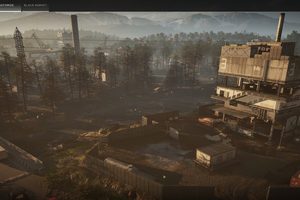










Teardown launched in 2022 and was already difficult to fault. A voxel-based heist sandbox where every wall, floor, vehicle, and fence is destructible, and the core loop — plan your route, break everything, grab the targets, and sprint out before the alarm timer expires — was one of the more quietly ingenious game designs in recent memory. Then in March 2026, Tuxedo Labs added multiplayer for up to 12 players. That changes things considerably.
What is the game about

The campaign casts you as an indebted demolition contractor slowly pulled into insurance fraud, car theft, and corporate sabotage. You learn the story through emails and TV news reports, both written with a dry humor that rewards actually reading them. Missions split between straightforward demolition jobs and more demanding heists — the latter requiring you to plan a route, punch shortcuts through walls, pre-position vehicles, and then execute everything in a single frantic sprint once the alarm triggers.
The planning phase is where Teardown earns its reputation. You walk around a level for as long as you like, blowing holes in fences, building improvised ramps, spray-painting arrows on surfaces to guide your future panicked self. Then you pull the trigger and have roughly 60 seconds to collect every objective before security arrives. That tension — constructed entirely by your own preparation — is something few games manage to replicate.
The destructibility that enables all of this is genuinely impressive. Fire spreads logically through wooden structures. Metal resists hammers but not blowtorches. A poorly placed nitroglycerine charge will take out load-bearing walls you needed. The voxel physics aren’t perfect — occasionally a building holds together on a single plank in ways that defy reason — but the system is consistent enough to plan around, which is what matters.
What Multiplayer Does to All of This

The short answer: it turns a methodical puzzle game into controlled chaos, and the result is frequently hilarious.
In single-player, heists reward patience and careful preparation. In multiplayer, you have 12 people with explosives and forklifts and differing opinions on the optimal route. What emerges is something closer to an improvisational disaster — someone drives a bulldozer through the wrong wall, someone else sets the escape vehicle on fire, and somehow you still pull off the heist with half a second to spare. The missions were designed for one person, but they translate to co-op surprisingly well precisely because the destructibility gives everyone something useful to do simultaneously.
Sandbox mode in multiplayer is its own category of experience. With unlimited resources, a group of players, and a fully destructible environment, the game essentially becomes a physics toybox. It’s not deep. It doesn’t need to be.
Private lobbies and public matchmaking are both available. Performance holds up reasonably well given what the engine is managing, though heavy destruction with multiple players will stress even capable hardware.
PC-Specific Considerations

On a well-specced desktop, Teardown runs excellently. The voxel engine is visually distinctive — lighting, water, fire, and smoke all look better than the blocky aesthetic might suggest, occasionally genuinely impressive — but it demands decent hardware to stay smooth during heavy destruction sequences. The minimum spec of a GTX 1060 with 4GB VRAM is realistic; pushing past that pays off.
The modding ecosystem on PC remains the platform’s biggest advantage over console versions. The Steam Workshop houses thousands of custom maps, tools, vehicles, and game modes, all built with the same editor the developers use. This substantially extends the game’s lifespan beyond the campaign and base sandbox. Lua scripting support means the community has produced some genuinely creative content, from custom heist scenarios to entirely new mechanics.
The campaign itself runs around 40 missions. A completionist run, including finding hidden valuables that unlock new tools, will take considerably longer. Dark World-style difficulty variants aren’t a feature here, but the challenge can be tuned through in-game settings without affecting achievements — a sensible design choice.
Where It Falls Short
The physics, while impressive, are not bulletproof. Occasionally structures behave in ways that feel more like a game engine approximating physics than actual physics, and on a few levels this affects whether a planned approach works or not. It’s minor, but noticeable.
The campaign also front-loads its best ideas. The early missions where you’re figuring out how everything works are more engaging than later missions where the tools are familiar and the challenge shifts toward execution rather than discovery.
Multiplayer, while genuinely fun, doesn’t add structured game modes beyond what already exists in single-player. There’s no dedicated competitive mode, no objective-based PvP. For some players that will be a non-issue. For others, the appeal will plateau faster than it might with more directed multiplayer design.
Verdict
Teardown: Teardown was already a well-constructed game with a clear identity. The multiplayer update doesn't reinvent it — it extends it, and does so in a way that suits the game's DNA. A sandbox built around creative destruction is, unsurprisingly, more entertaining with other people around to cause additional destruction. The campaign holds up as a solo experience, the modding community keeps the PC version alive long past the credits, and the core loop remains one of the more satisfying in the genre. – Tom Henry
If you passed on Teardown before, the multiplayer update is a reasonable prompt to revisit that decision.